Tuesday, December 28, 2010

Murex: The Imperial Purple Dye of Tyre


Dye Murex, Trunculariopsis (Murex) trunculus can be frequently seen on the muddy-rocky and/or algae covered intertidal-sub-tidal zones of the Mediterranean - Aegean system. A gland situated under the gills secretes a mucous liquid which may produce yellow, green, blue, red or the famous "royal purple" colors of the ancient Mediterranean peoples, according to the method used. (Photo credit: Mehmet Atatur http://www.treknature.com


For Kings only: the Tyrian Purple
The Emperors of Byzantium made a law forbidding anybody from using Tyrian Purple except themselves. The expression ‘born in the purple’ rose from this practice. But what is the amazing story behind these prohibitively expensive and legendary dyes today costing over 3 Million US$ a liter?


Three thousand years ago the Phoenicians controlled trade in purple dyed silks. The gland of the sea-snail Murex trunculus secretes a yellow fluid that, when exposed to sunlight, turns purple-blue. A similar dye, the Tyrian Purple was made from the Murex brandaris yielding purple red colors. Both dyes were extremely expensive. 


Ancient Phoenicia is renowned to have given the world the first phonetic (non syllable) based alphabet, a Mediterranean mercantile tradition with colonies like Carthage, and flourishing civilization the ancient Greeks owed a lot to. One lesser known contribution of the ancient "Lebanese" is the Purple Dye which came to be known as the Imperial Purple, that the Phoenicians of the city state Tyre extracted from the sea snail mollusks called Murex".The word 'purple' comes from the Old English purpul which originates from the Latin purpura. This in turn is derived from the Koine Greek πορφύρα (porphyra), name of the Tyrian purple dye manufactured in classical antiquity from a mucus secreted by the spiny dye-murex snail such as Murex trunculus and Murex brandaris. This extremely expensive dye was prized since ancient times and by the time of the Romans, the noblemen had already used it to color ceremonial robes and that became a royal "tradition" around the world. The most unusual aspect of Tyrian purple is the extracted color itself and its variations. In solution, the snail secretion color is blue but as a dye in the solid state it is purple. Just in case you just have to touch up an original Roman textile you can get genuine Tyrian purple dyes for $3,900 a gram or more than $3,000,000 a liter (2)!


Silk and Murex Dye:
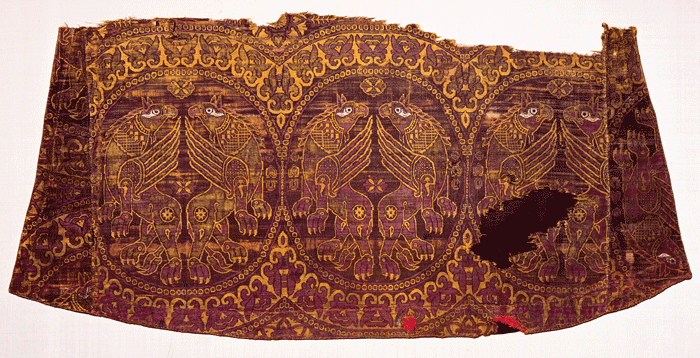
Among the more unlikely “marriages” arranged by human ingenuity is the one between the Chinese domesticated silk moth, Bombyx mori, and the Mediterranean sea snails Murex. The Murex dye, when brought together with silk, led to the world’s longest-lasting fashion statement.This fragment from an 11th-century Byzantine robe shows griffins embroidered on a delicate silk woven of murex-dyed threads. (6). Sion Switzerland, Église de Valère, Riggisberg (Philippa Scott, Saudi Aramco World)
Harvesting The Tyrian Purple Murex:
The mollusks needed by the Phoenicians were obtained with great difficulty. The Mediterranean sea has no tides and therefore does not uncover its shores at low water like the oceans. The mollusks prefer tolerably deep water and to procure them in any quantity it was necessary that they should be fished up from a certain depth: A long rope was let down into the sea, with baskets of reeds or rushes attached to it at intervals, constructed like lobster-traps baskets, with an opening that yielded easily to pressure from the outside, but resisted pressure from the inside, and made escape, when once the trap was entered, impossible. The baskets were baited with mussels or frogs, both of which had great attractions for the Murex /Purpuræ/, and were seized and devoured with avidity. At the upper end of the rope was attached to a large piece of cork, which, even when the baskets were full, could not be drawn under water. It was usual to set the traps in the evening,and after waiting a night, or sometimes a night and a day, to draw them up to the surface, when they were generally found to be full of the coveted Murex. (3).The snails were collected in large vats and left to decompose. 

Not much is known about the subsequent steps, and the actual ancient method for mass-producing the two murex dyes has not yet been successfully reconstructed; this special “blackish clotted blood” colour, which was prized above all others, is believed to be achieved by double-dipping the cloth, once in the indigo dye of H. trunculus and once in the purple-red dye of M. brandaris (5).

The Phoenicians established also a production facilities outside their traditional Lebanese shores, such as the one at Iles Purpuraires at Mogador, in Morocco.


Murex Purple dye and closely associated "royal" colors, so difficult to get in ancient times. There has been much speculation as to the precise colour the process actually produced by the Murex. Because of many variables in the process, Murex didn't produce any one colour. Sometimes the colour was the same as the flower “violets”, sometimes very similar to fuchsia. But garments of Tyrian Purple were supposedly produced by double-dyeing the fabric, which gave a darker colour. Consequently, the colour produced in that process wasn't “purple” as we understand purple but a dark crimson or even maroon (8).


Worth its Weight in Diamond


It is believed that it generally takes 12,000 snails to produce just 1.4 grams of this dye. Because of this, it was so expensive, that the historian Theopompus reported that,“Purple for dyes fetched its weight in silver”. Yet, there was a craze for this dye as a status symbol. In fact the Emperors of Byzantium made a law forbidding anybody from using it except themselves. The expression ‘born in the purple’ rose from this practice.


Dyes ancient, Dyes modern


Until modern times, all dyes were made in a similar manner, from animal sources and more often, plant sources. For example, cochineal (which gives a crimson colour) was made from the scale insect Kermes vermilio. To make one pound of dye, 70,000 insect bodies were boiled, dried, powdered and boiled again in ammonia. The red dye was then extracted by filtration and precipitation by alum. Indigo was extracted from leaves of the indigo plant (Indigofera tinctoria).
In 1909, Paul Friedländer discovered the chemical structure of Tyrian Purple (now called 6,6-dibromoindigo) and by then, the nature of the dye industry had completely changed. New dyes were now being made from the by-products of coal extraction. The first of these was mauve, synthesized by the British chemist William Henry Perkin from coal tar in 1856. As these dyes were cheaper and offered a wider range of colors, the need for natural dyes disappeared. And that’s why the clothes we buy today and no longer priced on the basis of colour! (1)


"Born in the Purple": Aristocracy and Power


Born in Purple: Byzantium Emperor Justinian I dressed in a robe dyed with Tyrian Purple. Interestingly, unlike other dyes that faded in sunlight, Tyrian purple would become darker.


Imperial Purple: From Constantine: until the half of Fifthcentury, the emperors were buried in immense red porphyry sarcophagi . Marcian (450-457) was the last to be honored with such a burial. For many emperors this stone was the first thing they saw, and the prestigious title “Porphyry Born” common within the emperors of Constantinople, meant they saw the light in the magnificent room called “born in the purple room”. It was a squared room of the Imperial Palace, roofed with a pyramid, all covered with red porphyry, where the empress gave birth to the imperial heirs. (Photo credit: http://dragons-intl.com)


The Imperial Purple tie of Prince William is surely not a random choice, nor the robe of the Pope Benedict XVI. Traditions continue, even if they go unnoticed by the general public. Here, William in an official photo with bride-to-be Kate Middleton at Buckingham Palace, 2010. http://www.celebitchy.com. 


The oldest known murex-dyed textile is a fine wool tapestry woven during the fifth to fourth centuries bc in Persia. Originally a garment, it was later adapted—in a well-worn condition—as a felt-lined horse trapping, which was buried with its owner (Philippa Scott - State Hermitage Museum, Saudi Aramco World)


It's a purple world!
Beyond the Mediterranean, there are a number of other sea snails useful for dyeing but none equalled Murex. Some 140 species flourish off the shores of North and South America. Of these, Purpura patula, Purpura persica and Purpura aperta inhabit the Gulf of Mexico, and these are still valued today in Central America, where women use them to color yarn. Sun and saltwater cause the pigment to oxidize on the fibers into an attractive but uneven purple. Unlike the Mediterranean types of Murex, which must be crushed in order to obtain the tiny sac of pigment, the gland on the American shellfish is closer to the surface, and the creature can be persuaded to squirt its secretion onto the yarn. Afterward, the shellfish can be put back into the sea, given time to recover, and used again. Threads colored in this way tend to retain a fishy smell, however. The dyes in many pre-Columbian textiles and the purple paint in the Nahuatl codices have been analyzed and found to be shellfish purple.
 

In ancient Japan yet another type of shellfish was used. In the waters around Scandinavia and the British Isles, the Anglo-Saxons called purple dye "fiscdeag" (“fish dye”), and in the seventh century the Venerable Bede wrote about red and purple dyes obtained from sea snails. In Australia, although there are equivalent shellfish, no evidence has yet been found that these were ever used for textile dyeing.(7) 


Phoenicia gave us more than the Purple Dye: Phonetic Alphabet, sea trade and Carthage.


According to legend the first purple dye was discovered by Herakle-Melqart city god of Tyre) who was walking along the Levantine shoreline with the nymph Tyrus. His dog found a Murex snail and devoured it, which left a beautiful purple color around the dog's mouth. Tyrus saw the color and told Herakle-Melqart she would not accept his courtship until he brought her a robe of the same color. So he collected the Murex shells, extracted the dye, and tinted the first garment purple.


Byblos, Sidon and Tyre were the main Phoenician cities and traded with many countries round the Mediterranean, especially Italy. The Phoenicians first traded in Italy with the Etruscan, a society of artisans skilled in the art of jewelry making. However, it was with the creation of Imperial Rome by Romulus in 753 B.C. that the Murex’s purple dye began to be synonymous with power,wealth and position.
The exports of Phoenicia as a whole included particularly cedar and pine wood, fine linen from Tyre, Byblos, and Berytos (ancient Beirut), cloths dyed with the famous Murex Tyrian purple, embroideries from Sidon, metalwork and glass, glazed faience, wine, salt, and dried fish. They received in return raw materials, such as papyrus, ivory, ebony, silk,amber, ostrich eggs, spices, incense, horses, gold, silver, copper, iron, tin, jewels, and precious stones. The name Byblos is Greek; papyrus received its early Greek name (byblos,byblinos) from its being exported to the Aegean through Byblos. Hence the English word Bible is derived from byblos as "the (papyrus) book." (3)


The ancient Phoenician city of Tyre was named after after the rocky formation on which the town was originally built. Tyre means “rock”, adjective for Tyre is Tyrian. Tyre was a Phoenician island city founded around the third millennium BC and known as Queen of the Seas. In the 10th century BC, King of Tyre, Ahiram, joined two peninsulas by landfill and extended the city further by reclaiming a considerable area from the sea and built two ports and a temple to Melkart, the city's God.
Tyre grew wealthy from its far-reaching Phoenician colonies and its industries of purple-dyed textiles in the first millennium BC. The Phoenician expansion began about 815 B.C. when traders from Tyre founded Carthage in North Africa, of which Hannibal is the famous historical leader challenging Rome. 
Eventually Phoenician colonies spread around the Mediterranean and even the Atlantic, bringing to the city a flourishing maritime trade. In 332 B.C. Alexander the Great set out to conquer this strategic coastal base in the war between the Greeks and the Persians. Unable to storm the city, he blockaded Tyre for seven months. Alexander was so enraged at the Tyrians' defense and the loss of his men that he destroyed half the city. The Romans later built great important monuments in the city, including an aqueduct, a triumphal arch and the largest hippodrome in antiquity.
Taken by the Islamic armies in 634 Tyre strong fortifications enabled to resist to the Crusaders until 1124. After about 180 years of Crusader rule, the Mameluke retook the city in 1291, and then it passed on to the Ottomans at the start of the 16th century. With the end of the World War I Tyre was integrated into the new nation of Lebanon, a few miles north of the highly volatile border with Israel.


The legendary shell Murex.This is a specimen of Haustellum haustellum, sometimes named as the Mouse Murex also known as Snipe's bill Murex and Woodcock Murex, a denizen of the Indo-Pacific region(Photo: Mehmet Atatur: Trek Nature)


Murex dye with different shades: an example of Suzani Bokhara, Uzbekistan Silk on cotton, circa 1840. Trellis design on center field;murex dye used in flowers on border; irises, pomegranates and carnations throughout. 90 in x 57 ( http://www.estherfitzgerald.com)


But what is the secret of this color purple and why was it so unique in history?
There is simply no other color so closely attached to Greeks and Romans but royal purple very well known and as Porphyra (πορφύρα) . It was a custom during the early ages of Christianity, to write their most important manuscripts in gold or silver letters upon vellum stained with royal purple. These manuscripts were produced in this manner in order to be able to present the stronger proof of the high degree of respect with which they were made.(4)


The color of your robe indicates your social class
Today, clothes of all colors cost the same. But did you know that a few generations ago, the cost depended on the color of the cloth? This was because dyes were expensive to obtain. Tyrian Purple was a dye so expensive that only kings could afford it!

The imperial robes of Roman emperors were Tyrian purple trimmed in metallic gold thread. The badge of office of a Roman Senator was a stripe of Tyrian purple on their white toga. Tyrian purple was continued in use by the emperors of the Eastern Roman Empire until its final collapse in 1453. In medieval Europe, blue dyes were rare and expensive, so only the most wealthy or the aristocracy could afford to wear them. (The working class wore mainly green and brown.) Because of this (and also because Tyrian purple had gone out of use in western Europe after the collapse of the Western Roman Empire in AD 476), Europeans’ idea of purple shifted towards this more bluish purple known as royal purple because of its similarity to the royal blue worn by the aristocracy. This was the shade of purple worn by kings in medieval Europe.


Shades of the Murex: Thistle Lilac, Mauve, Violet, Orchid, Magenta, Fuchsia, Dark Magenta, Purple, Plum, Dark Orchid, Dark Violet Indigo, Lavender, Wine, Heliotrope, Royal Purple, Mulberry, Aubergine… No matter what the name is they all have in common the blended colors of blue and red. (http://slovenian.wunderground.com/blog)


Jesus, too, is Born in Purple?: depicted and dressed as a Roman soldier but wearing royal purple and gold. He is "trampling" the devil (snake) as well as Rome (the lion), and is holding the scriptures which read "I am the way, the truth and the life." By the 5th Century, such a claim would have been acceptable. (photo credit: Alamo.edu)

 
The port city of Tyre (Today's Sour in South Lebanon) was the ancient capital of Phoenicia and was best known for the production of purple dye extracted from the murex sea snail. The city's strategic and commercial value made it a target of many conquests, and several civilizations have left behind their architectural and cultural legacies. Roman ruins in the Al-Bas district include the largest and best-preserved Roman hippodrome—or horse racing arena—in the Middle East, which held more than 20,000 spectators.(Photo credit 1996- National Geographic Society).

The first phonetic alphabet was the most important gift of the Phoenicians to the world. The Greek alphabet was directly inspired from these. Complicated and non practical Alphabets based on syllables rather than sounds were out.

References:

1: Human Touch of Chemistry http://www.humantouchofchemistry.com/purple
2: www.most-expensive.com

3, 4: http://Phoenicia.org

5: Greek Heraldry Society 6: Philipa Scott: http://www.saudiaramcoworld.com/issue/200604/millennia.of.murex.htm:  

7: Philipa Scott, Saudi Aramco World, p. 30-37, July/August 2006.  

8: http://www.lexorandi.es/Aliturgico/colorviolaceo.htm

Krikor Tersakian, 2010 Montreal, Canada

Wednesday, September 1, 2010

Mount Lebanon's odd couple: The Druze and the Maronites


A sectarian map of Lebanon: note the Maronite and Druze strongholds at the very heart of the country. The Sunni have a heavy presence in the major coastal towns from Tarablus (Tripoli) to Sayda (Sidon) and the sparsely populated north. The south and the fertile Beqaa valley to east are predominantly Shi'a, strongholds of the Hizbullah and the Amal Movement.
Druze leader Walid Jumblatt wondered in 2009 "The Maronites and Druze have become the red Indians of Lebanon. In light of the Sunni-Shiite conflict in the region, there is a new Lebanon and a new political geography will surface ". (Al-Akhbar daily)'"
These remarks are so true and explain in a nutshell the fact that the Christian Maronites and the heterodox Shi'a sect called the Druze have been Lebanon's historical backbone. These two communities have now somehow been relegated to a back seat position by the emergence of the Sunni and the Shi'a communities both in power and demographics. 

Lebanese politics is mainly a perpetual challenge to preserve the extra fragile balance between the 18 officially recognized sects and communities. Lebanon has always been and will remain a land of fragile coexistence between theses various factions. Today most of the headlines go to the classical rivalry between the Sunni and the Shi'a Islam communities, yet historically the greatest struggle and love-hate relationship of Lebanon were between the Christian community called the Maronites and the Druze. They can be considered the historical main founding fathers of today's Lebanon and some would argue the country was carved out of Greater Syria to accommodate them in an independent country. I will try to explain both what unites and what divides these two rival communities, which I call Lebanon's Odd couple.

The Cedar of Lebanon, Cedrus Libani.  Mount Lebanon used to be almost completely covered with cedars. The superb qualities of the cedar wood, beautiful color, hardness, exquisite fragrance, resistance to insects, humidity and temperature,incited Phoenicians, Egyptians, Greeks and others to use it extensively. The Phoenicians built their trade ship and military fleets from cedar wood. Kings David's and Salomon's Palaces were not the exception.  Cedar may attain a height of 120' , a diameter of 9' feet and live for centuries. Today after centuries of over-cutting, there only a few hundred trees left mostly in the north near the Maronite Becharreh village and in  the Druze controlled Barouk area. Note the protective walls around the gorge above built in the 19th century to keep out grazing animals. (photo credit: Habeeb.com)
Lebanon is an indispensable passageway on the east shores of the Mediterranean sea, north of Biblical Palestine. It is crossroads of cultures and a cradle of human civilization since its Phoenician past. Modern day Lebanon is definitely the product of colonial manipulations and hotel room agreements between France and Great Britain. The idea was to carve a land somehow dominated by mostly West leaning Christian minorities, spearheaded by the Maronites. What was known as Greater Syria was divided. Lebanon maybe a small country in size (10,450 km2), but there is no shortage of reasons to constantly keep the pressure cooker hot and ready for the next explosion.

Lebanon has always been unique and a land where more than 18 ethnic and religious communities cohabit but also constantly compete and clash. The Sunni or the Shi'a and the Druze on the Muslim side and on the Christian side the Maronites, the Greek Orthodox,  the Greek Catholic (Melchites), Armenians, Assyrians and Syriac. Other ethnic and religious communities such as Alawites, Kurds, Palestinians, Protestants, Assyrians are also present and active. (Note: like the Maronites, the Greek Catholic and the Syriac Catholic are in communion with the Vatican).

Is there a particular reason for Lebanon's such diverse mosaic and often clashing cultures? One of the easiest explanations is the existence of the two mountain chains of Mount Lebanon and Anti Lebanon running parallel to the Mediterranean. This unique topography in a region of vastly flat land has allowed for many fringe or minority groups to historically settle there in the coastal areas and up in the mountains for relative safety. From the Hittites to the Hellenistic, Roman, Byzantine, Arab Islam, Crusades, Ayyubid, Ottomans, Mameluke to the French Colonial rule, Lebanon has seen and tasted it all: but the country of the Cedar has always remained  a refuge for many persecuted and minority groups and all this reflected in the co-existing communities making up a rich and very volatile mosaic of the tiny country.

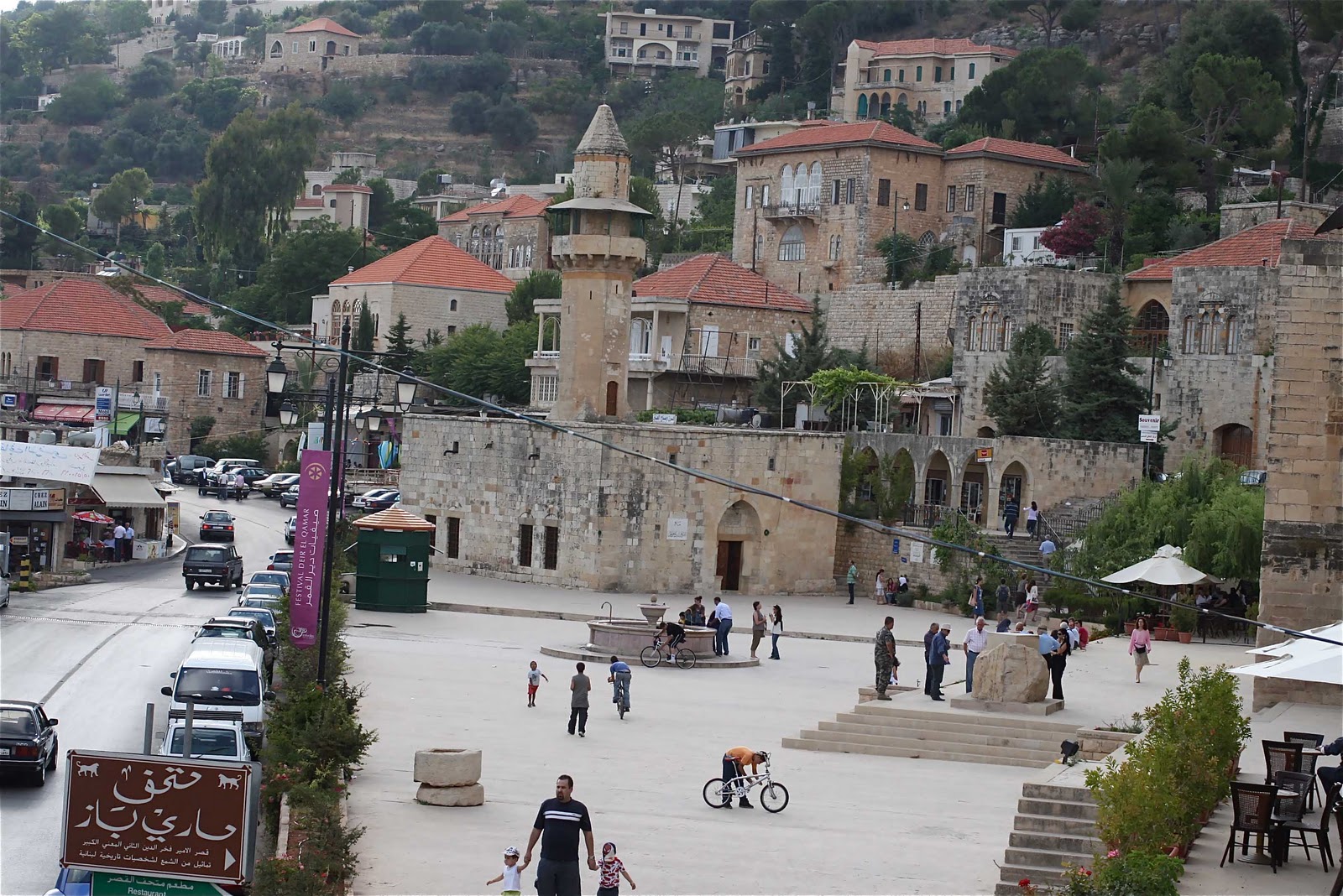
Deir el Qamar: The quintessential Maronite-Druze mixed town, central to both communities as well as Capital of the Emirs of Mount Lebanon. It was the scene of violent confrontation and massacres between the Druze and the Maronites notably in 1860 and the 1980's civil war, the Druze gaining the upper hand on all occasions. Deir El-Qamar is unique in Lebanon, declared a World Heritage by UNESCO. Shortly after Emir Fakhreddine II came to power in 1590, a chronic water shortage in nearby Baaqline forced him to move his capital to Deir Al-Qamar and ruled there until his death in 1635. The town remained the residence of the governors of Lebanon until the 18th century, when Emir Bechir II Chehab moved the capital to Beiteddine (see below). In the square there is a mosque constructed in 1493 by Emir Fakhreddine I Maan for his Muslim mercenary soldiers. Behind the mosque is a 19th century Souk as well as a Silk Khan. Nearby is the 17th  century synagogue, built to serve the Jewish population, some of whom were part of the immediate entourage of Emir Fakhreddine II.


Lebanon has a strange and unjust looking political system based on ethnic representative quota. The system seems obsolete but necessary to keep the very fragile "entente" or political consensus between the factions. Maronites have long been relegated to third spot with their low birth rates (who can compete with the Shi'a and the Sunnites?), but they still have the top jobs reserved for them by the political consensus still in place. Lebanon is the only Arab nation with a Christian (Maronite) President, Commander of the Army and other top key posts.

Two communities at the very heart of the Mount Lebanon and at the very epicenter of Modern Lebanese history of miracles and disasters. Sunnis were (are) mostly city dwellers having the protection of centuries of Sunni Empires, while the Shi'a, a tiny minority in the Near east were always marginalized and even oppressed. The Near East is a Sunni dominated area since the Omayyad Empire.

Maronites and the Druze: Centuries long rivalry, cohabitation, massacres, mutual hate and respect. A bittersweet love and hate relationship of two communities, both so fragile and yet so pivotal to the region.


Christian heartland Jounieh bay seen from the Maronite Cathedral. Jounieh is just north of the capital Beirut (photo credit:www.skyscrapercity.com)

Maronite odyssey started after the 5th century when Christian monks followers of a hermit named Maroun, arrived from the Orontes valley in Northern Syria and began preaching their religion to the inhabitants of the northernmost parts of the mountain range. In the late 8th century a group known as the Maradites (also Jarajima) settled in North Lebanon following the order of the Byzantine Emperor, their mission was to raid Islamic territories in Syria. They merged with the local population refusing to leave after the emperor struck a deal with the Muslim Caliph of Damascus, thus they became part of the Maronite society. And in 1291 AD after the fall of Acre, the last crusader outpost in the Levant, the remnants of the European settlers who succeeded in escaping capture by the Mamelukes settled in the Northern part of Lebanon, becoming part of the Maronite society. (Note that the private militia of Maronite Franjieh family in North Lebanon is called the Marada after the Maradites)

On the Druze side, In the 9th century, tribes from the "Jabal el Summaq" area north of Aleppo, in Syria began settling the southern half of the mountain range. These tribes were known as the Tanoukhiyoun and in the 11th century they converted to the Druze faith and ruled the areas of Mount Lebanon stretching from Metn in the north to Jezzine in the south, this entire area became known as the ‘Jabal ad-Duruz’. In the early 17th century, Emir Fakhreddine the 2nd ascended the throne in the Druze part of the mountains known as the Chouf. In an effort to unify Mount Lebanon, Emir Fakhreddine opened the door to Christian and in particular Maronite settlement of the Chouf and Metn.

In the 18th century scores of Maronites gradually settled in the Druze regions of the Mount. The Druze came to see these new Maronite arrivals as a threat in the region. Various clashes occured in the 1840s. Finally in 1860s an ugly and very bloody civil war erupted in the area and resulted in the massacre of thousands of Christians from Mount Lebanon to the Bekaa valley towns (Zahleh) as well as Damascus.

The Druze won ugly on the battlefields but the net political result was somehow different as the Europe (mainly France and Britain) intervened and forced the weakened Ottoman Empire to divide Mount Lebanon into two areas; Druze and Maronite.  In 1861 the "Mount Lebanon" autonomous district was established within the Ottoman system, under an international guarantee. The new governor was a non Lebanese christian Ottoman subject called the Mutasarrif ruling over this Mutasarrifiya (district).

In the following years a bloody inter Druze power struggle forced some Druze to leave Mount Lebanon and migrate to Jabal al-Druze in southern Syria. The extreme military hostilities between the Druze and the Maronites resumed during the Lebanese civil war, again the Druze gaining the upper hand in their regions most of the times. Both now have faded to a somehow secondary roles due to the emergence of the mainstream Islam (Shi'a and Sunni majorities).

The Druze and the Maronites, are too few and scattered to have viable independant states on their own. They live with caution  and try to influence the best they can their environement and survive. Kamal Jumblatt, the father of Lebanon’s current Druze leader Walid Jumblatt, once explained his people this way: “Ever alert, [Druze] gauge their surroundings and choose their words carefully, assessing what must be said and what can be said.”

They’re loyal to whoever is in charge of the country they live in. Syria’s Druze side with Bashar Assad and the Baath Party. Lebanon’s Druze forge alliances with the majority coalition of local political parties, or with whoever is ruling Lebanon from the outside. Israeli Druze support and defend the Zionist project. The Druze on the Golan are no different from Israeli or Lebanese Druze in this way, but their political geography is different. Though they’re governed by Israel now, they may be governed again by Syria later. So even though Israel offers them citizenship, most haven’t taken it. They’re afraid of the consequences if Syrian rule ever returns.(1)

Maronites: Resilience and survival in a sea of Islam


The Maronite Cross is also referred to as an Antiochene Cross. Antioch (Antakya, Անտիոք), an ancient city in present day Turkey, was converted to Christianity through the ministry of the apostle Paul and fellow missionary Barnabas. Saint Peter himself was the first bishop and the church extended its territory and became one of the original patriarchates. In 518 yet another dogmatic squabbling split the church into two groups: the Chalcedonians and the monophysist anti-Chalcedonians. A century later, the Chalcedonians divided into the Syriacs, the Maronites and the Melkites. By the seventh century, the Assyrians and had also their own Patriarch, and by the twelfth century the Latin Patriarch was established. (Photo credit:Seiyaku)


Maronites is a term given to the early followers of Maron, a priest and a hermit. He followed the path walked by Peter and Paul, and spent his life teaching about the faith. After converting an old pagan temple into a church, he ministered to many people from there with the gift of healing and counsel By emigration Maronites spread to Cyprus, Palestine. Egypt etc and now number about one million. Their liturgy (said mainly in liturgical Syriac) is of the Antioch type, with innovations taken from the Latin rite. Maronites are full in communion with the Vatican and their their patriarch lives in Lebanon (Bkerké). As in other Eastern rites, the parish priests are usually married. The Maronites have been a distinct community since the 7th cent., when they separated in a doctrinal dispute. they returned to communion with the pope in the 12th cent. In the 19th cent., the massacres of Maronites by the Druze brought French intervention; this gave France its modern hold in Lebanon and Syria during the post WWI era in an ill fated colonial mandate that lasted into the WWII when France as a nation fell apart and lost her grip on her colonies.


In the fourth century, a monk called Maron left Antioch for the Orontes River to lead an ascetic way of life. When he died (410 AD) his followers built a monastery in his honor and this became the foundation of the Maronite Church. Staunchly Chalcedonian, the Maronite monks were persecuted by the Monophysites and after 350 of their monks were slaughtered, the survivors exiled themselves to the mountains of Lebanon.  (photo credit: Seiyaku)


In the year 687, the Maronites arrived into Mount Lebanon where they elected John Maron as their first patriarch. This established Lebanon as their third geographical center, as well as the full formation of the Maronite Church. Maronites are Catholics, whose Mother Church is in Lebanon. Spread across the world are the daughter communities. Often the sons and daughters of Maron are referred to as Beit Maroun, (the house of Maron).


The Maronite Church integrates three fundamental traditions. Antioch, the center which influenced the Maronite Churches biblical theology and use of the literal sense of scripture. Edessa, where St Ephrem lived, influenced the prayer and hymns of the Maronites. Lastly, Mount Lebanon, provided the base where the Maronite monastic life, worship and traditions begin.


St Hardini Monastery. Like any self respecting catholic church, the Maronites have many saints including St Charbel, St Hardini and St Rafca.


Lebanese Maronite president elect Bashir Gemayel (1947-1982), portrayed as the shadow of Jesus, protector of the Christian faith and as the leader of the Lebanese Forces. He led a fight against a coalition of leftists, Druze,  Muslim and the Palestinians during the Lebanese civil war. Bashir was assassinated immediately after his election as President, during the ill fated Israeli invasion of 1982. He was indeed a very direct and inspirational leader although very divisive along the sectarian lines. The cross at the right is the Lebanese christian Forces logo, while the word in Arabic translates as "We shall survive". (photo credit: falangist.com)

A Maronite clergyman blessing a Tank and the soldiers during the Lebanese Civil War. The Maronite led Christian militia were fighting a coalition of Leftist, Muslim and Palestinians groups.


Christian militia praying on the battlefront somewhere in Beirut, a city long divided along sectarian lines during the Civil War. Lebanese political tensions today are more along the competing Sunnite - Shi'a lines rather than rightist Christian and their foes. 


Christian right wing Lebanese Forces were the brainchild of Bashir Gemayel, the younger son of the Phalangist (Kata'eb) Party founder Pierre Gemayel.  He somehow forcibly formed a military coalition of the right wing christian militias fighting the left and the Palestinians until his election as President of the Republic and assassination in 1982.

Druze: Small in numbers, great in influence and history


Emir Fakhreddine Maan, the maverick Druze Prince of Mount Lebanon 1590-1635
The Druze may represent only about 5% of the population, but their historical and factual importance is much more than that. They have been at the very heart of the Lebanese identity, which they have shaped along with their rival communities, especially the Maronites. The Druze religion has its roots in Ismailism, a religio-philosophical movement which founded the Fatimid Caliphate in Egypt in the tenth century. During the reign of al-Hakim (996 - 1021) the Druze creed came into being, blending Islamic monotheism with Greek philosophy and Hindu influences. Active proselytizing of the new creed was brief; since about 1050 the community has been closed to outsiders.

The first Druze settled in what is now southern Lebanon and northern Israel. By the time of the Ottoman conquest of Syria (1516), Druze also lived in the hill country near Aleppo, and Sultan Selim I recognized Fakhr al-Din as Emir of the Druze, with local authority. Civil strife between the Lebanese Druze and the Maronite Christians ended in 1860 with the autonomous administration of Mt. Lebanon, which was imposed by the great powers. The Druze never regained ascendancy in the region and the center of the community passed to Mt. Hauran in Syria, which became known as Jabal-el-Druze (Mountain of the Druze) - the name formerly synonymous with Mt. Lebanon.
Until the end of Ottoman rule (1918), the Druze were governed by emirs, as a semi-autonomous community. In 1921 the French tried to set up a Druze state under the French Mandate, but the attempt failed. (re: Jewish virtual library)

Druze Beliefs and Traditions

The Druze consider their faith to be a new interpretation of the three monotheistic religions: Judaism, Christianity and Islam. For them, the traditional story of the Creation is a parable, which describes Adam not as the first human being, but as the first person to believe in one god. Since then, the idea of monotheism has been disseminated by "emissaries" or prophets, guided by "mentors" who embody the spirit of monotheism. In addition to Biblical saints, the Druze hold other influential people in great esteem, such as the Egyptian Akhenaton, the Greek philosophers Socrates, Plato and Aristotle, and Alexander the Great. 

Although the Druze recognize all three monotheistic religions, they believe that rituals and ceremonies have caused Jews, Christians, and Muslims to turn aside from "pure faith". They argue that individuals who believe that God will forgive them if they fast and pray, will commit transgressions in the expectation of being forgiven - and then repeat their sins. The Druze thus eliminated all elements of ritual and ceremony; there is no fixed daily liturgy, no defined holy days, and no pilgrimage obligations. The Druze perform their spiritual reckoning with God at all times, and consequently need no special days of fasting or atonement.

The Druze religion is secret and closed to converts. From the theological perspective, the secrecy derives from the tenet that the gates of the religion were open to new believers for the space of a generation when it was first revealed and everyone was invited to join. Since in their belief everyone alive today is the reincarnation of someone who lived at that time, there is no reason to allow them to join today. Therefore, the Druze refrain from  any missionary activities, and no member of another religion can become Druze.

Druze religious books are accessible only to the initiates, the uqqal ("knowers"). The juhhal ("ignorant ones") accept the faith on the basis of the tradition handed down from generation to generation (re: The Jewish virtual Library).

Druze heartland:BEITEDDINE PALACE, Built on a rocky spur dominating a deep valley, this splendid example of Lebanese architecture was conceived and built by the Emir Bechir Chehab II who ruled Lebanon from 1788 to 1840. There are many galleries, balconies and high-ceiling reception rooms with marble mosaic floors, carved ceilings, colored glass windows and wall fountains. Today the palace, which is 42 kilometers from Beirut, houses an ethnographic museum of feudal weapons, costumes and jewelry, as well as an impressive display of Byzantine mosaics. (Photo credit:Lebanon the Legend)

Emir Bachir, a major Druze leader


Beiteddine Palace in Chouf, Lebanon: (Photo: Petteri Sulonen)

Druze leader maverick Walid Jumblatt (born in 1949) in his Moukhtara (Chouf District) palace in front of his late father Kamal's (1917-1977) portrait. Kamal was a great personality, both as a political and as a inspirational figure for the Lebanese Left coalition and the Druze community. He was a key figure on the National stage, opposed to the Government and the Christian forces during the Lebanese Civil War and was assassinated presumably by the Syrian intelligence forces during the Civil war in Lebanon over policy disagreements with Damascus (photo: theatlantic.com) 


Walid Jumblatt is the major political Druze figure in Lebanon but not the only one in importance. Other prominent Druze families include the Arslan and other chiefs of  dynasties such as as the Ma'an, Shehab, Yamani,  Here, Walid Jumblatt is seen paying respects during a funeral of an assassinated Druze by rival forces allied to the Hizbullah.

Druze elders in Golan Heights. Druze communities live across the Syrian and Israeli de facto borders in this highly militarized area. Some Druze left Mount Lebanon and emigrated to Syria (Jabal Druze) after the battle of Ain Dara where one faction defeated another and caused an exile.
The Druze village of Majdal Shams (Tower of the Sun) on the Golan Heights. The area on either side of the heavily militarized Israel - Syria de facto borders is home to many Druze villages and communities separated by the warring armies (Photo: Michael Totten)

  Druze community leader in Lebanon Sheikh Nayim Hassan receiving His Holiness Aram I, Catholicos of the Holy See of Cilicia. Both Druze and Armenians are important minorities in Lebanon where the balance between the communities is so intricate and fragile. 


Krikor Tersakian 2010, Canada


Monday, May 10, 2010

St. Chora's amazing High Definition mosaics

Ten megapixel Mosaics!


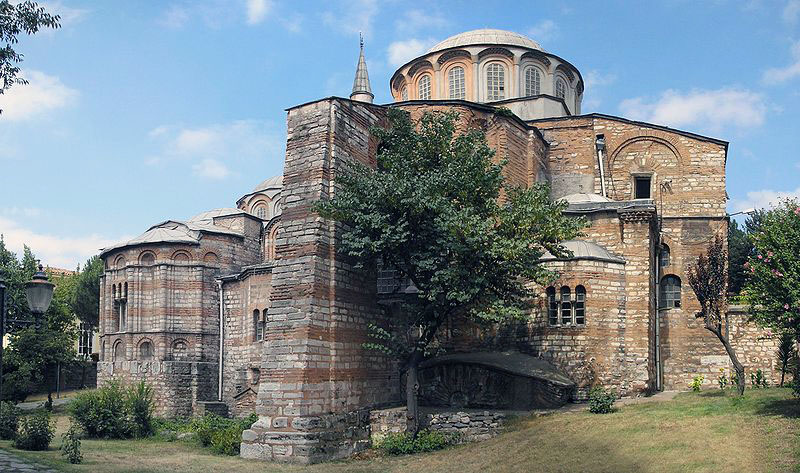
St. Chora Church is not the most impressive of the Byzantine churches but it has arguably the best mosaics of the era (10-12th century), all executed when the fate of Constantinople was very clear with the city surrounded by the Ottoman forces. The church is best known for housing some of the best preserved mosaics and frescoes from the late-Byzantine period and considered among the very best in the world. (Photo: Krikor Tersakian)
St. Chora High Definition mosaic: St. Paul at St. Chora church. Unsurpassed quality. 


It is funny, but every time I mention the Chora church to friends in Montreal, they think I am talking eggs, fruits and and pancakes ! You see, "Cora" is a pretty successful breakfast serving chain in Quebec owned by a Greek businesswoman, while I am trying to talk about the Chora church in Constantinople that houses the best Byzantine Mosaics and Frescoes, arguably the finest in the world!

The world had to wait until very recently for the introduction of High Definition TV and screens, but the incredible and unparalleled mosaics of St. Chora church were executed in "HD" in the 14th century! Some of the mosaic stones used are smaller than rice grains and the overall quality and execution are unparalleled. Mosaic is a very difficult art, and the Chora church is the ultimate temple of this lost but very noble Art.

St. Chora Church (known also as Kariye Museum) is a rather ordinary looking and medium sized church but amazingly it has some of the very best Byzantine mosaics of the 12-14 century to be found anywhere. Constantinople or Istanbul is long known as a city with layer upon layer of cultural riches and heritage dating from ancient times. But beyond all the obvious and universally acclaimed sites, St. Chora is a jewel that’s rarely seen or known. Therefore easily confused with the Montreal breakfast chain by some...


The Chora Church was originally built outside the defensive walls of Constantinople on the south of the Golden Horn, 4 Km west of  HaghiaSophia and Topkapi. The church's full name was the Church of the Holy Saviour in the Country (Greek ἡ Ἐκκλησία του Ἅγιου Σωτῆρος ἐν τῃ Χώρᾳ, hē Ekklēsia tou Hagiou Sōtēros en tē Chōra). The name, Chora referring to its location originally outside of the walls, became the shortened and accepted name of the church. The original church on this site was built in the early 5th century, and stood outside of the 4th century walls of Constantine the Great. However, when Theodosius II built his impregnable land walls in 413–414, the church became incorporated within the city's defenses, but retained the name Chora. The church became an important stopping point for Pilgrims on their way to the Holy Land.
Early in the 12th century, the church suffered a partial collapse, perhaps due to an earthquake and was rebuilt. However, it was only after the third phase of building, two centuries after, that the church as it stands today was completed.

Therefore the majority of the current building dates from 1077–1081, when Maria Ducaena, the mother-in-law of Alexius I Comnenus, rebuilt the Chora Church as an inscribed cross (quincunx), which was a popular architectural style of the time. Early in the 12th century, the church suffered a partial collapse, perhaps due to an earthquake. The church was rebuilt by Isaac Comnenus, Alexius's third son. However, it was only after the third phase of building, two centuries after, that the church as it stands today was completed.

The powerful Byzantine statesman Theodore Metochites endowed the church with much of its fine mosaics and frescoes. Theodore's impressive decoration of the interior was carried out between 1315 and 1321, thee mosaic-work being the finest example of the Palaeologus Renaissance. In 1328, Theodore was sent into exile by the Andronicus III but later was allowed to return and lived as a monk his last two years in the church.  Finally in 1453 The Ottoman occupied the city through a defensive lapse very near the St. Chora church at Edirne Kapi. The Byzantine soldiers knew their surrounded city was doomed and were resting, praying and finding solace at the Chora.


After theOttoman conquest under the Sultan Fatih, this unique church Around became a mosque. Fifty years after the fall of Constantinople to the Ottomans (in 1453), Atık Ali Paşa, the grand vizier of Sultan Bayazid II, ordered the Chora Church be converted into a mosque — Kariye Camii. Due to the prohibition against images in Islam, the mosaics and frescoes were mostly left unharmed but were covered behind layers of plaster. This and frequent earthquakes in the region had taken their toll on the artwork until their restoration. Another earthquake in 1894 did not help either.

In 1948 the scholar Thomas Whittemore (Dumborton Oaks Byzantine Institute, Washington D.C.) who had done restoration work at the Haghia Sofia, sponsored also a audacious program of restoration of the unique art at the Chora, removing the plaster and restoring the artwork to its splendor. Awesome mosaics and frescoes were discovered, unique in their fine detail, displaying very subtle shadings and very rich colors that are unknown or lacking in earlier Byzantine mosaics. From that time on, the Chora church ceased to be a functioning mosque. In 1958, it was opened to the public as a museum — Kariye Müzesi. In today's Istanbul, St. Chora Haghia Sofia in the pecking order. Still, it is a must see of universal importance.

A Brief history of the lost art of the mosaics 


It is very difficult to elaborate about the exacts origins of the mosaic art as various civilizations from Mesopotamia to Rome have somehow excelled in their own right and not always in religious themes. Purely decorative mosaics with geometrical patterns were also mastered along with the mythological characters, saints, earthly or heavenly scenes etc. Early Christians adopted mosaics fast and made them an integral part of church decorations. Mosaics were indeed extensively used both the secular dwellings as well as religious buildings throughout the Roman Empire and the Mediterranean basin.

Despite all this, it is safe to argue that mosaics were most popular in the Eastern Roman Empire and hence were perfected by the Byzantines and therefore the Orthodox Christian rites. Others, such as Venice and other Italian cities also mastered the art as they were in constant friendly (and not so friendly) contact with Byzantium. The mosaics were an ancient roman tradition but in my view they reached their perfection under the Byzantines as witnessed in the St. Chora and a few churches and monasteries. 

Mosaic is described as an art where the collage of small pieces of glasses, glazed clays, shells, pebbles, stones and even semi precious stones are used to create a decoration (images, landscapes, religious scenes, geometrical patterns etc.). The stones or glasses are cut to different shapes and the multicolor assemblage is used to create the final work "in situ" (on site, that is in a palace, cathedral, monastery etc).  The glasses of different colors are referred to as tesserae and are combined to create the art.

With the rise of the Byzantine Empire from the 5th century onwards, centered on Byzantium (now Istanbul, Turkey), the art form took on new characteristics. These included Eastern influences in style and the use of special glass tesserae called smalti, manufactured in northern Italy. These were made from thick sheets of colored glass. Smalti have a rough surface and contain tiny air bubbles. They are sometimes backed with reflective silver or gold leaves to enhance the overall finish resulting in mesmerizing overall effects.


St. Chora Church dome: High Definition photo or mosaics of Highest quality? This mosaic, in the southern dome of the inner narthex, depicts the ancestry of Christ and his ancestors. In particular, Adam through Jacob are listed, along with the sons of Jacob. (Photo Mirari Erdoiza)
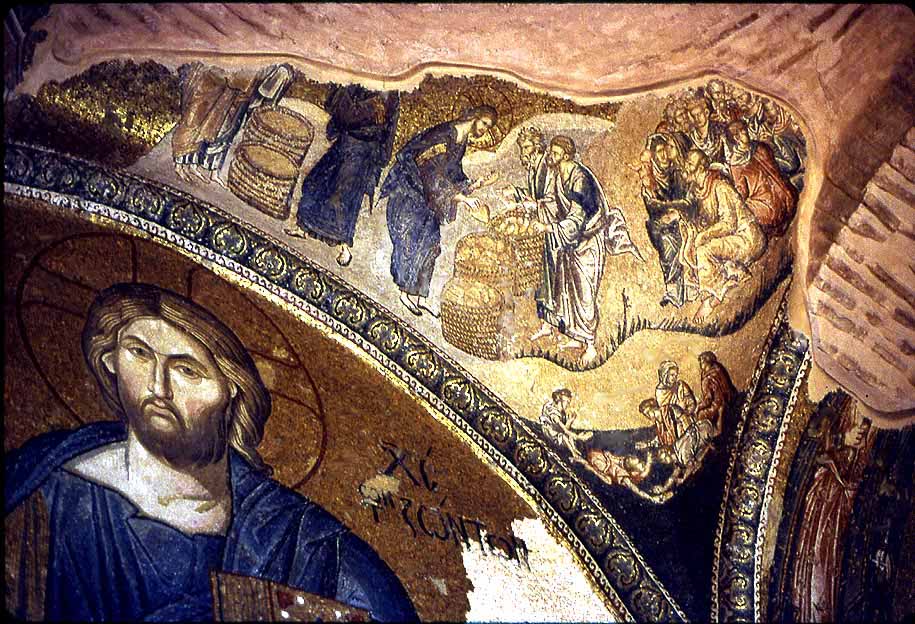
St. Chora: Christ the Savior (Left) and the miracle of Christ multiplying the bread to feed the 5000 followers. (Photo: Rolfgross)
HD screens are not needed here: You have to see to believe that this is not some modern poster, painting or a fresco. This is the mosaic just inside the main door. It depicts the famous image of Christ Pantocrator (Photo: pages.pomona.edu)


St. Chora: Byzantine mosaic depiction of Christ. When the church was built in the 5th Century, Istanbul was still known as Constantinople. The mosaic tiles were added to the interior walls in the 14th century and are considered to be amongst the finest examples of Byzantine art.
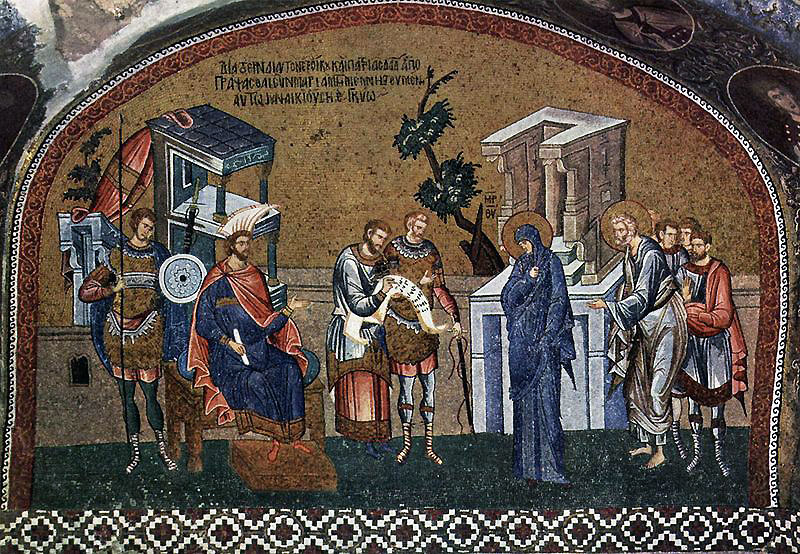
St. Chora: Mosaic of the journey to Bethlehem (photo: choramuseum.com).The walls are decorated with superb 14th century mosaics, illustrating scenes from the life of Christ and the Virgin Mary. These are the finest masterpieces of Christian religious art to be found anywhere in the world. Paintings, rocks and architectural designs seen in the background make the pictures three-dimensional. The scenes are made with special care for them to look daily, lively and ordinary. The scenes are enriched with explicating stories near them. 
Like the mosaics and the frescoes inside, the architecture of the St. Chora is artfully distorted, chaotic, asymmetrical and decorative. (Choramuseum.com)


Mosaic closeup: small mosaic ceramic pieces at Chora in need of repair, showing the stunning range of colors used. It’s not easy to do but it is well worth the effort. The interior walls are covered with exquisite Byzantine religious art that has no equal anywhere in the world. (Choramuseum.com)


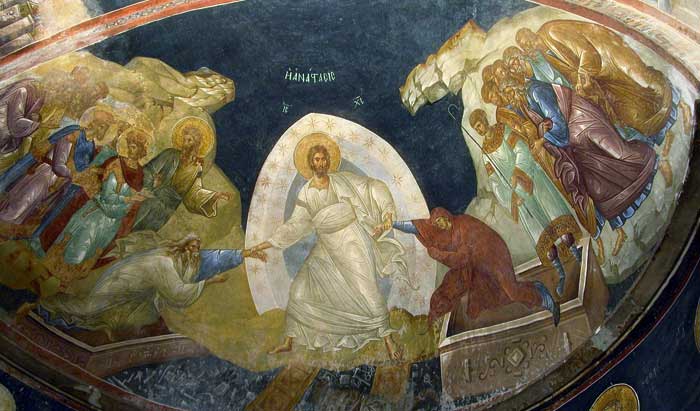
The Frescoes in St Chora are also in High Definition: This is the Anastasis (or Resurrection) scene. Christ, who had just broken down the gates of Hell, is standing in the middle and trying to pull Adam and Eve out of their tombs. Behind Adam stand John the Baptist, David and Solomon. Others are righteous kings;(Photo:Mlahannas.de)


Constantinople's defensive walls today, near the St Chora church: a stunning contrast of Old and New: These walls are named after Emperor Theodosius, and I took this picture at Edirnekapi very near the point the Ottoman army finally breached the Byzantine defenses and conquered the besieged city in 1453. The Chora church is only a few hundred feet away. The mobile fruit vendor, the black Audi and the car behind parked in an opposite direction make a stunning tableau of this historic place. Climbing these monstrous fortifications gave me my first ever vertigo and I really feared for my life unsure how to come down safely without losing my balance. (Photo: Krikor Tersakian)

The St. Chora when it was still used as a Mosque then still called Kariye Camii (circa 1904). The mosaics were under then hidden under a layer of white plaster hiding them from view and few knew about their existence.  Note the Golden Horn and Beyoglu Pera at the far left. This area now is totally surrounded by concrete working class dwellings and known to be  a conservative Muslim Fatih neighborhood.


The Pammakaristos church: Another forgotten Byzantine jewel


Only a few hundred meters from the St. Chora stands another masterpiece of Byzantine culture, namely the Pammakaristos (Greek: Θεοτόκος ἡ Παμμακάριστος, "All-Blessed Mother of God") church which is today known as the Fethiye Mosque or museum. It does have very valuable mosaics even though not as elaborate as those at the St. Chora. It is in the area called Çarsamba in Fatih neighborhood and was built on the fifth hill of Constantinople in the beginning of 12th century and then rebuilt in the 13th century by Michael Glabas Ducas Tarchaniotes, nephew of the emperor Michael VIII Palaeologos. After the fall of the City in 1453, Pammakaristos was used as a nunnery and then it became the see of the exiled Orthodox Patriarchate from 1455 until 1587.

In 1590, the church was inevitably converted into a mosque Fethiye (conquest or conqueror), in order to commemorate the conquest of Georgia and Azerbaijan by the Turks under the reign of Sultan Murad III during the Iranian war. A part of the apse was removed and a niche (Mihrab) was built showing the direction of Mecca for Muslim prayers along with a minaret and a religious teaching school or madrassah.
Pammakaristos church was then neglected for a long period until its restoration in 1949 by the Byzantine Institute of America (see details below). Just like the St. Chora, in the mid 20th century the frescoes and mosaics were cleaned and the famous church became a museum but it is far less visited than the St Chora and understandably so.
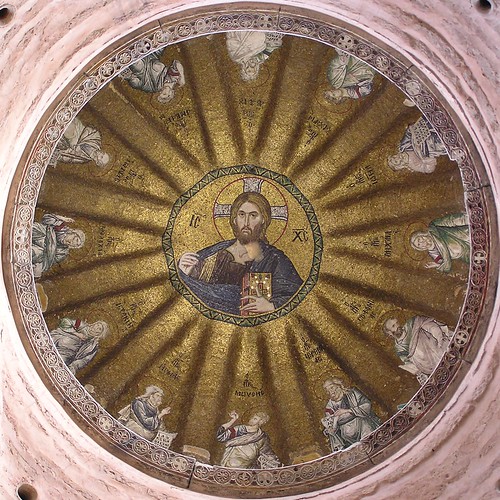
 At the entrance, there is a well preserved frescoes on the wall with "three wise men", and some fragments of other frescoes. Inside the dome and the interior walls of the parekkleison are covered with mosaics from the 14th century. The dome is decorated with Christ Pantokrator and the Twelve Prophets. In the apsis, there are figures of Christ with Virgin Mary and John the Baptist forming the Deesis, and archangels watching them. In the vaults and arches, there are scenes of the Baptism, and of several saints and monks of the church (www.greatistanbul.com)


 Pammakaristos Pantocrator church dome mosaics: (Photo: phool 4xc FlickR)


Pammakaristos: St. Gregory Illuminator (Սուրբ Գրիգոր Լուսաւորիչ) mosaic   14th century: St Gregory or Krikor was the driving force behind the conversion of Armenia from paganism to Christianity in 301 A.D. and hence the founder of the Armenian Apostolic church. He was initially imprisoned by the Armenian king Tirdad I (Տրդատ թագաւոր) but he managed to convert the King to Christianity along with the Nation (the first in the world to do so). His son Aristakes was his successor as head of the newly formed Church and took part to the famous First council of Nicaea in 325 A.D., the first ecumenical council of bishops of the Christian Church under Constantine. The above mosaic at the Pammakaristos church is very interesting but a bit odd given the conflict and competition opposing the Byzantines to the independent Armenian Apostolic church. 


This mosaic at Haghia Sofia may be the most famous of them all, but the overall quality of the surviving artwork (frescoes and mosaics) at St Chora is in a different league. (Photo: Krikor Tersakian)


Real life Indiana Jones: In 1948, Thomas Whittemore (1871 – 1950) and Paul A. Underwood, from the Byzantine Institute of America and the Dumbarton Oaks Center for Byzantine Studies, sponsored a program for restoration of the Chora in Istanbul. Thomas Whittemore was a scholar, archaeologist, born in Cambridge, Massachusetts in 1871. His good personal relationship with Ataturk enabled him to gain permission from the government to start the preservation and restoration of the Haghia Sophia mosaics in 1931. Under the plaster he discovered close to a thousand years of history—in silver, gold, marble, and sparkling glass cubes put together into a parade of saints and influential sinners which stretches from 537 to 1453 A.D., when the Turks came marching in, and then started work at the Chora restoring the place to its splendor (Choramuseum.com)


Bicephalous Eagle: The Byzantine Imperial flag: The double-headed eagle was the symbol of the Palaiologos, the last Greek-speaking "Roman" dynasty to rule from Constantinople. Emperor Michael VIII Palaiologos recaptured Constantinople from the catholic Crusaders in 1261, from a state based in Asia Minor; the double-headed eagle symbolized the dynasty and was kept despite the fact that virtually all of the Asian possessions were being gradually gobbled up by the Turks. This symbol was also adopted by the Greek Orthodox Ecumenical Patriarchate as well as the Russians.


The tragedy of open air mosaics and historical treasures in the Middle East 

Beit Meri, Lebanon: an example of open air Roman mosaic floor in total neglect


I grew up an Lebanon, a country considered to be an open air museum. The country is small in size, but few can claim to have seen all the historical sites the cradle of ancient Phoenicia has to offer. From the earliest human settlements all the way to Hellenistic, Roman, Byzantine, Arab, Crusader, Mameluke, Ottoman or French colonial rule, the country is a one stop shopper's paradise. However all is not so rosy. Some sites are unprotected and the concrete urban jungle threatens most. The Lebanese National Museum with all its unique Phoenician and other treasures was heavily damaged and sacked during the civil war.  But this is by no means a tragedy unique to Lebanon. Archaeological sites across the region are left unprotected and are crying for help.


Another tragedy happened in Baghdad upon the absurd Iraqi invasion by all time great American visionary leader and philosopher called George W. Bush. More than ten thousands antiquities of different sizes were looted in April 2003 from the National museum. These unique treasures were illegally sold all around the world, but fortunately most but not all were eventually recovered. In a typical answer as to why the US forces did not secure the museum from theft and looting, the official answer from the General Richard Myers was that while the looting was taking place at the museum, lots of people were dying because of the fighting. Therefore the museum with the unique Mesopotamian artifacts was not a priority for the attacking troops...

As for mosaics, the picture is even bleaker in the region because of the very fragile nature of these assemblages. For example when I was a kid, we used to sometimes visit the Roman site in the Village of Beit Meri near Beirut where there are open air mosaics  and we used to actually walk on them just for fun! Yes, we were pretty ignorant, innocent and supervision free to walk on these thousand years mosaics. I still deeply regret doing so.

The sorry state of some archaeological sites in the Near East and elsewhere is beyond belief even though deliberate acts of vandalism seem to be rare. But is this acceptable ?

There are not many options available other than the complete protection of all historical sites with the help (both financial and technical) of the International community, agencies, universities and even philanthropists who understand a basic fact: what is lost today is never recovered.

The great 19th century Armenian Humorist / Satirist Hagop Baronian (1843 Edirne-1891 Constantinople) summed it best: ''Look to your rear side to see in front of you'' (Ետեւդ նայիր որ առջեւդ տեսնես). That is, History is not just the past, it is also the best interpretation and the road map to understand and somehow predict the future.
 
Tyre, Lebanon: Neglected open air mosaics. It is in the Roman period that mosaics in Lebanon started to appear.The Hellenistic period from 400 B.C until the Roman period have not yielded any mosaic pavement in Lebanon particular during its prosperous period of the 2nd century A.C-Mosaics continue to flourish during the Byzantine period until the Arab conquest. Important finds of mosaic pavements have been made in many archaeological sites, in churches and in ancient houses.  Lebanon has become thus one of the most important centers for the study of mosaics. (Photos: Cedarrick)
Lebanon mosaics in total neglect: Please, please, please: Can anyone be caring and smart enough to put these broken mosaic pieces together and lift them a few centimeters off the ground for protection?  Or maybe not. After all, not many care...


Krikor Tersakian  June 2010, Canada