Monday, May 10, 2010

St. Chora's amazing High Definition mosaics

Ten megapixel Mosaics!


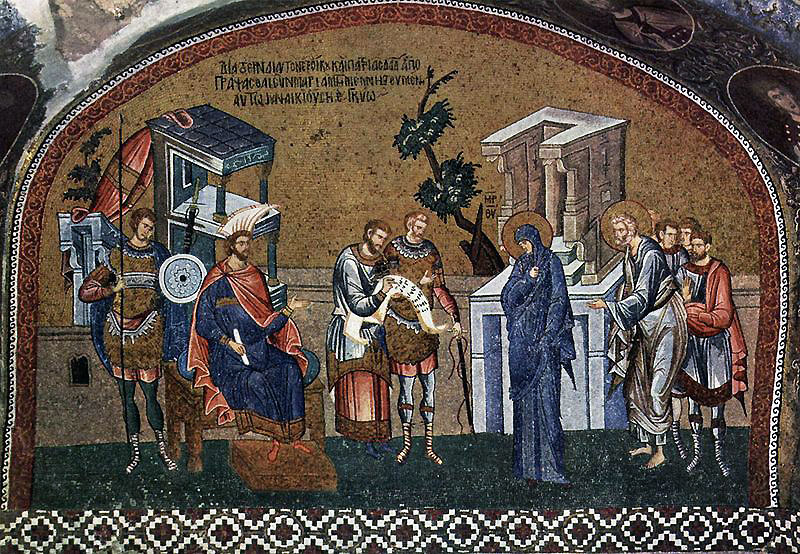
St. Chora Church is not the most impressive of the Byzantine churches but it has arguably the best mosaics of the era (10-12th century), all executed when the fate of Constantinople was very clear with the city surrounded by the Ottoman forces. The church is best known for housing some of the best preserved mosaics and frescoes from the late-Byzantine period and considered among the very best in the world. (Photo: Krikor Tersakian)
St. Chora High Definition mosaic: St. Paul at St. Chora church. Unsurpassed quality. 


It is funny, but every time I mention the Chora church to friends in Montreal, they think I am talking eggs, fruits and and pancakes ! You see, "Cora" is a pretty successful breakfast serving chain in Quebec owned by a Greek businesswoman, while I am trying to talk about the Chora church in Constantinople that houses the best Byzantine Mosaics and Frescoes, arguably the finest in the world!

The world had to wait until very recently for the introduction of High Definition TV and screens, but the incredible and unparalleled mosaics of St. Chora church were executed in "HD" in the 14th century! Some of the mosaic stones used are smaller than rice grains and the overall quality and execution are unparalleled. Mosaic is a very difficult art, and the Chora church is the ultimate temple of this lost but very noble Art.

St. Chora Church (known also as Kariye Museum) is a rather ordinary looking and medium sized church but amazingly it has some of the very best Byzantine mosaics of the 12-14 century to be found anywhere. Constantinople or Istanbul is long known as a city with layer upon layer of cultural riches and heritage dating from ancient times. But beyond all the obvious and universally acclaimed sites, St. Chora is a jewel that’s rarely seen or known. Therefore easily confused with the Montreal breakfast chain by some...


The Chora Church was originally built outside the defensive walls of Constantinople on the south of the Golden Horn, 4 Km west of  HaghiaSophia and Topkapi. The church's full name was the Church of the Holy Saviour in the Country (Greek ἡ Ἐκκλησία του Ἅγιου Σωτῆρος ἐν τῃ Χώρᾳ, hē Ekklēsia tou Hagiou Sōtēros en tē Chōra). The name, Chora referring to its location originally outside of the walls, became the shortened and accepted name of the church. The original church on this site was built in the early 5th century, and stood outside of the 4th century walls of Constantine the Great. However, when Theodosius II built his impregnable land walls in 413–414, the church became incorporated within the city's defenses, but retained the name Chora. The church became an important stopping point for Pilgrims on their way to the Holy Land.
Early in the 12th century, the church suffered a partial collapse, perhaps due to an earthquake and was rebuilt. However, it was only after the third phase of building, two centuries after, that the church as it stands today was completed.

Therefore the majority of the current building dates from 1077–1081, when Maria Ducaena, the mother-in-law of Alexius I Comnenus, rebuilt the Chora Church as an inscribed cross (quincunx), which was a popular architectural style of the time. Early in the 12th century, the church suffered a partial collapse, perhaps due to an earthquake. The church was rebuilt by Isaac Comnenus, Alexius's third son. However, it was only after the third phase of building, two centuries after, that the church as it stands today was completed.

The powerful Byzantine statesman Theodore Metochites endowed the church with much of its fine mosaics and frescoes. Theodore's impressive decoration of the interior was carried out between 1315 and 1321, thee mosaic-work being the finest example of the Palaeologus Renaissance. In 1328, Theodore was sent into exile by the Andronicus III but later was allowed to return and lived as a monk his last two years in the church.  Finally in 1453 The Ottoman occupied the city through a defensive lapse very near the St. Chora church at Edirne Kapi. The Byzantine soldiers knew their surrounded city was doomed and were resting, praying and finding solace at the Chora.


After theOttoman conquest under the Sultan Fatih, this unique church Around became a mosque. Fifty years after the fall of Constantinople to the Ottomans (in 1453), Atık Ali Paşa, the grand vizier of Sultan Bayazid II, ordered the Chora Church be converted into a mosque — Kariye Camii. Due to the prohibition against images in Islam, the mosaics and frescoes were mostly left unharmed but were covered behind layers of plaster. This and frequent earthquakes in the region had taken their toll on the artwork until their restoration. Another earthquake in 1894 did not help either.

In 1948 the scholar Thomas Whittemore (Dumborton Oaks Byzantine Institute, Washington D.C.) who had done restoration work at the Haghia Sofia, sponsored also a audacious program of restoration of the unique art at the Chora, removing the plaster and restoring the artwork to its splendor. Awesome mosaics and frescoes were discovered, unique in their fine detail, displaying very subtle shadings and very rich colors that are unknown or lacking in earlier Byzantine mosaics. From that time on, the Chora church ceased to be a functioning mosque. In 1958, it was opened to the public as a museum — Kariye Müzesi. In today's Istanbul, St. Chora Haghia Sofia in the pecking order. Still, it is a must see of universal importance.

A Brief history of the lost art of the mosaics 


It is very difficult to elaborate about the exacts origins of the mosaic art as various civilizations from Mesopotamia to Rome have somehow excelled in their own right and not always in religious themes. Purely decorative mosaics with geometrical patterns were also mastered along with the mythological characters, saints, earthly or heavenly scenes etc. Early Christians adopted mosaics fast and made them an integral part of church decorations. Mosaics were indeed extensively used both the secular dwellings as well as religious buildings throughout the Roman Empire and the Mediterranean basin.

Despite all this, it is safe to argue that mosaics were most popular in the Eastern Roman Empire and hence were perfected by the Byzantines and therefore the Orthodox Christian rites. Others, such as Venice and other Italian cities also mastered the art as they were in constant friendly (and not so friendly) contact with Byzantium. The mosaics were an ancient roman tradition but in my view they reached their perfection under the Byzantines as witnessed in the St. Chora and a few churches and monasteries. 

Mosaic is described as an art where the collage of small pieces of glasses, glazed clays, shells, pebbles, stones and even semi precious stones are used to create a decoration (images, landscapes, religious scenes, geometrical patterns etc.). The stones or glasses are cut to different shapes and the multicolor assemblage is used to create the final work "in situ" (on site, that is in a palace, cathedral, monastery etc).  The glasses of different colors are referred to as tesserae and are combined to create the art.

With the rise of the Byzantine Empire from the 5th century onwards, centered on Byzantium (now Istanbul, Turkey), the art form took on new characteristics. These included Eastern influences in style and the use of special glass tesserae called smalti, manufactured in northern Italy. These were made from thick sheets of colored glass. Smalti have a rough surface and contain tiny air bubbles. They are sometimes backed with reflective silver or gold leaves to enhance the overall finish resulting in mesmerizing overall effects.


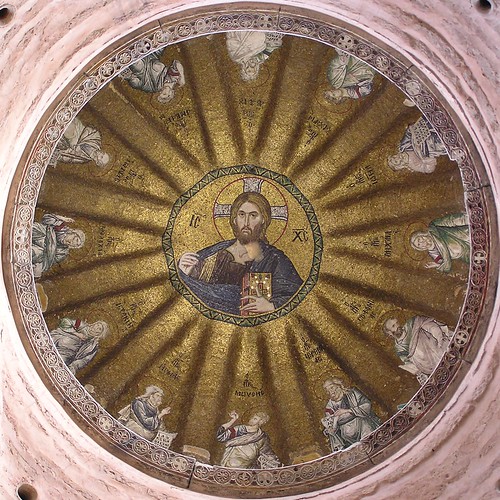
St. Chora Church dome: High Definition photo or mosaics of Highest quality? This mosaic, in the southern dome of the inner narthex, depicts the ancestry of Christ and his ancestors. In particular, Adam through Jacob are listed, along with the sons of Jacob. (Photo Mirari Erdoiza)
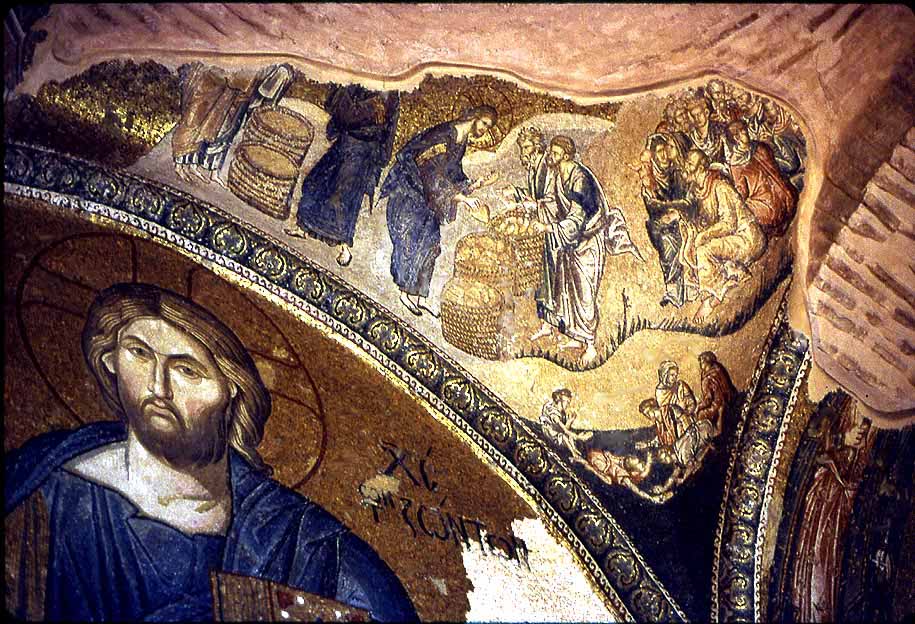
St. Chora: Christ the Savior (Left) and the miracle of Christ multiplying the bread to feed the 5000 followers. (Photo: Rolfgross)
HD screens are not needed here: You have to see to believe that this is not some modern poster, painting or a fresco. This is the mosaic just inside the main door. It depicts the famous image of Christ Pantocrator (Photo: pages.pomona.edu)


St. Chora: Byzantine mosaic depiction of Christ. When the church was built in the 5th Century, Istanbul was still known as Constantinople. The mosaic tiles were added to the interior walls in the 14th century and are considered to be amongst the finest examples of Byzantine art.
St. Chora: Mosaic of the journey to Bethlehem (photo: choramuseum.com).The walls are decorated with superb 14th century mosaics, illustrating scenes from the life of Christ and the Virgin Mary. These are the finest masterpieces of Christian religious art to be found anywhere in the world. Paintings, rocks and architectural designs seen in the background make the pictures three-dimensional. The scenes are made with special care for them to look daily, lively and ordinary. The scenes are enriched with explicating stories near them. 
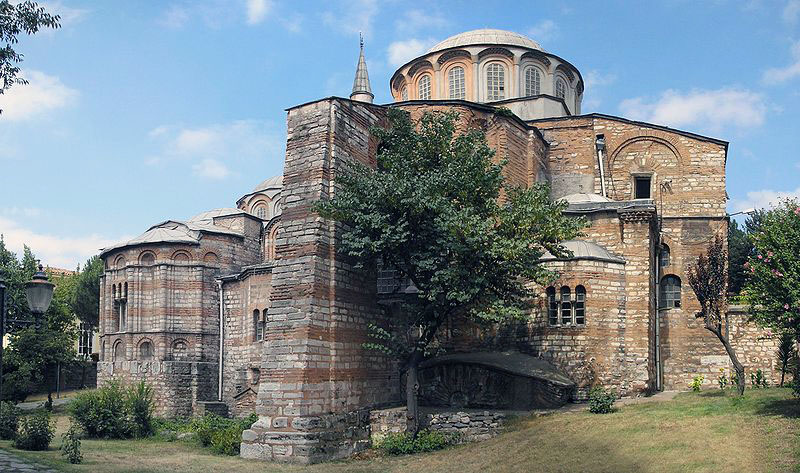
Like the mosaics and the frescoes inside, the architecture of the St. Chora is artfully distorted, chaotic, asymmetrical and decorative. (Choramuseum.com)


Mosaic closeup: small mosaic ceramic pieces at Chora in need of repair, showing the stunning range of colors used. It’s not easy to do but it is well worth the effort. The interior walls are covered with exquisite Byzantine religious art that has no equal anywhere in the world. (Choramuseum.com)
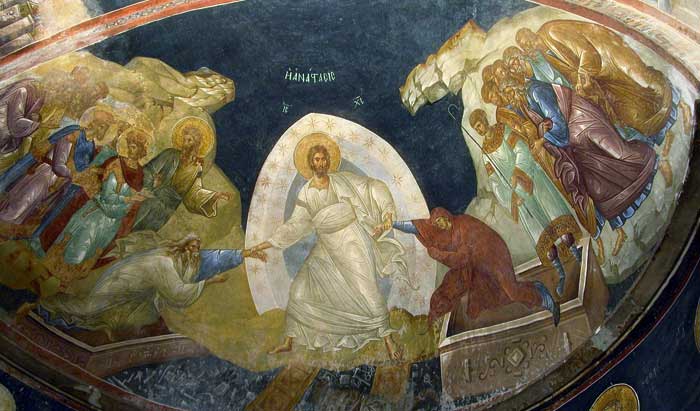

The Frescoes in St Chora are also in High Definition: This is the Anastasis (or Resurrection) scene. Christ, who had just broken down the gates of Hell, is standing in the middle and trying to pull Adam and Eve out of their tombs. Behind Adam stand John the Baptist, David and Solomon. Others are righteous kings;(Photo:Mlahannas.de)


Constantinople's defensive walls today, near the St Chora church: a stunning contrast of Old and New: These walls are named after Emperor Theodosius, and I took this picture at Edirnekapi very near the point the Ottoman army finally breached the Byzantine defenses and conquered the besieged city in 1453. The Chora church is only a few hundred feet away. The mobile fruit vendor, the black Audi and the car behind parked in an opposite direction make a stunning tableau of this historic place. Climbing these monstrous fortifications gave me my first ever vertigo and I really feared for my life unsure how to come down safely without losing my balance. (Photo: Krikor Tersakian)

The St. Chora when it was still used as a Mosque then still called Kariye Camii (circa 1904). The mosaics were under then hidden under a layer of white plaster hiding them from view and few knew about their existence.  Note the Golden Horn and Beyoglu Pera at the far left. This area now is totally surrounded by concrete working class dwellings and known to be  a conservative Muslim Fatih neighborhood.


The Pammakaristos church: Another forgotten Byzantine jewel


Only a few hundred meters from the St. Chora stands another masterpiece of Byzantine culture, namely the Pammakaristos (Greek: Θεοτόκος ἡ Παμμακάριστος, "All-Blessed Mother of God") church which is today known as the Fethiye Mosque or museum. It does have very valuable mosaics even though not as elaborate as those at the St. Chora. It is in the area called Çarsamba in Fatih neighborhood and was built on the fifth hill of Constantinople in the beginning of 12th century and then rebuilt in the 13th century by Michael Glabas Ducas Tarchaniotes, nephew of the emperor Michael VIII Palaeologos. After the fall of the City in 1453, Pammakaristos was used as a nunnery and then it became the see of the exiled Orthodox Patriarchate from 1455 until 1587.

In 1590, the church was inevitably converted into a mosque Fethiye (conquest or conqueror), in order to commemorate the conquest of Georgia and Azerbaijan by the Turks under the reign of Sultan Murad III during the Iranian war. A part of the apse was removed and a niche (Mihrab) was built showing the direction of Mecca for Muslim prayers along with a minaret and a religious teaching school or madrassah.
Pammakaristos church was then neglected for a long period until its restoration in 1949 by the Byzantine Institute of America (see details below). Just like the St. Chora, in the mid 20th century the frescoes and mosaics were cleaned and the famous church became a museum but it is far less visited than the St Chora and understandably so.
 At the entrance, there is a well preserved frescoes on the wall with "three wise men", and some fragments of other frescoes. Inside the dome and the interior walls of the parekkleison are covered with mosaics from the 14th century. The dome is decorated with Christ Pantokrator and the Twelve Prophets. In the apsis, there are figures of Christ with Virgin Mary and John the Baptist forming the Deesis, and archangels watching them. In the vaults and arches, there are scenes of the Baptism, and of several saints and monks of the church (www.greatistanbul.com)


 Pammakaristos Pantocrator church dome mosaics: (Photo: phool 4xc FlickR)


Pammakaristos: St. Gregory Illuminator (Սուրբ Գրիգոր Լուսաւորիչ) mosaic   14th century: St Gregory or Krikor was the driving force behind the conversion of Armenia from paganism to Christianity in 301 A.D. and hence the founder of the Armenian Apostolic church. He was initially imprisoned by the Armenian king Tirdad I (Տրդատ թագաւոր) but he managed to convert the King to Christianity along with the Nation (the first in the world to do so). His son Aristakes was his successor as head of the newly formed Church and took part to the famous First council of Nicaea in 325 A.D., the first ecumenical council of bishops of the Christian Church under Constantine. The above mosaic at the Pammakaristos church is very interesting but a bit odd given the conflict and competition opposing the Byzantines to the independent Armenian Apostolic church. 


This mosaic at Haghia Sofia may be the most famous of them all, but the overall quality of the surviving artwork (frescoes and mosaics) at St Chora is in a different league. (Photo: Krikor Tersakian)


Real life Indiana Jones: In 1948, Thomas Whittemore (1871 – 1950) and Paul A. Underwood, from the Byzantine Institute of America and the Dumbarton Oaks Center for Byzantine Studies, sponsored a program for restoration of the Chora in Istanbul. Thomas Whittemore was a scholar, archaeologist, born in Cambridge, Massachusetts in 1871. His good personal relationship with Ataturk enabled him to gain permission from the government to start the preservation and restoration of the Haghia Sophia mosaics in 1931. Under the plaster he discovered close to a thousand years of history—in silver, gold, marble, and sparkling glass cubes put together into a parade of saints and influential sinners which stretches from 537 to 1453 A.D., when the Turks came marching in, and then started work at the Chora restoring the place to its splendor (Choramuseum.com)


Bicephalous Eagle: The Byzantine Imperial flag: The double-headed eagle was the symbol of the Palaiologos, the last Greek-speaking "Roman" dynasty to rule from Constantinople. Emperor Michael VIII Palaiologos recaptured Constantinople from the catholic Crusaders in 1261, from a state based in Asia Minor; the double-headed eagle symbolized the dynasty and was kept despite the fact that virtually all of the Asian possessions were being gradually gobbled up by the Turks. This symbol was also adopted by the Greek Orthodox Ecumenical Patriarchate as well as the Russians.


The tragedy of open air mosaics and historical treasures in the Middle East 

Beit Meri, Lebanon: an example of open air Roman mosaic floor in total neglect


I grew up an Lebanon, a country considered to be an open air museum. The country is small in size, but few can claim to have seen all the historical sites the cradle of ancient Phoenicia has to offer. From the earliest human settlements all the way to Hellenistic, Roman, Byzantine, Arab, Crusader, Mameluke, Ottoman or French colonial rule, the country is a one stop shopper's paradise. However all is not so rosy. Some sites are unprotected and the concrete urban jungle threatens most. The Lebanese National Museum with all its unique Phoenician and other treasures was heavily damaged and sacked during the civil war.  But this is by no means a tragedy unique to Lebanon. Archaeological sites across the region are left unprotected and are crying for help.


Another tragedy happened in Baghdad upon the absurd Iraqi invasion by all time great American visionary leader and philosopher called George W. Bush. More than ten thousands antiquities of different sizes were looted in April 2003 from the National museum. These unique treasures were illegally sold all around the world, but fortunately most but not all were eventually recovered. In a typical answer as to why the US forces did not secure the museum from theft and looting, the official answer from the General Richard Myers was that while the looting was taking place at the museum, lots of people were dying because of the fighting. Therefore the museum with the unique Mesopotamian artifacts was not a priority for the attacking troops...

As for mosaics, the picture is even bleaker in the region because of the very fragile nature of these assemblages. For example when I was a kid, we used to sometimes visit the Roman site in the Village of Beit Meri near Beirut where there are open air mosaics  and we used to actually walk on them just for fun! Yes, we were pretty ignorant, innocent and supervision free to walk on these thousand years mosaics. I still deeply regret doing so.

The sorry state of some archaeological sites in the Near East and elsewhere is beyond belief even though deliberate acts of vandalism seem to be rare. But is this acceptable ?

There are not many options available other than the complete protection of all historical sites with the help (both financial and technical) of the International community, agencies, universities and even philanthropists who understand a basic fact: what is lost today is never recovered.

The great 19th century Armenian Humorist / Satirist Hagop Baronian (1843 Edirne-1891 Constantinople) summed it best: ''Look to your rear side to see in front of you'' (Ետեւդ նայիր որ առջեւդ տեսնես). That is, History is not just the past, it is also the best interpretation and the road map to understand and somehow predict the future.
 
Tyre, Lebanon: Neglected open air mosaics. It is in the Roman period that mosaics in Lebanon started to appear.The Hellenistic period from 400 B.C until the Roman period have not yielded any mosaic pavement in Lebanon particular during its prosperous period of the 2nd century A.C-Mosaics continue to flourish during the Byzantine period until the Arab conquest. Important finds of mosaic pavements have been made in many archaeological sites, in churches and in ancient houses.  Lebanon has become thus one of the most important centers for the study of mosaics. (Photos: Cedarrick)
Lebanon mosaics in total neglect: Please, please, please: Can anyone be caring and smart enough to put these broken mosaic pieces together and lift them a few centimeters off the ground for protection?  Or maybe not. After all, not many care...


Krikor Tersakian  June 2010, Canada

Sunday, January 17, 2010

Symphony of Stones: from Garni Gorge to Giant's Causeway

Part I: The Garni Gorge and Giant's Causeway: Two unique sites of Basalt Symphony. 
Part II: The incredible Story of the Girona Spanish Armada warship wrecked in 1588 AD near Giant's Causeway, Northern Ireland; The death of 1300 people on board and the recovery of its treasures.
Part III: The Hellenistic Garni Temple complex watching over the unique Garni Gorge near Yerevan, Armenia 


Part I: The Garni Gorge and Giant's Causeway: distant cousins but part of the same Basalt Symphony


Northern Ireland's Giant Causeway, circa 1890 AD. The scenery of course is unchanged today. One century is the equivalent of just one minute for these 50 million years old natural wonders. 40,000 columnar rocks make the Causeway one of the most amazing natural sites on earth, yet it was almost unknown until the 18th century!

The amazing fact about Northern Ireland's most popular tourist attraction is that it was almost unknown to the world and even to most Britons as late as 1730 AD.  The Giant's Causeway today is a world renowned miles long natural miracle, but the site was strangely overlooked or simply misunderstood for centuries. Very few knew about its existence just 50 miles from Belfast in the County Antrim near the village Bushmills (famous for its Irish Whiskey distillery). Even fewer people seemed to care enough to inquire about or plan a visit to the Causeway. Some had seen sketches of the site, but the sheer size and beauty of the Causeway was still under a dark blanket of ignorance.

It is believed that it was only after a talented visitor painted some realistic sketches of the site and exposed them to a wider public in Dublin, that a general interest started to grow first in Britain and slowly across the Continent. Exactly how these wonderful various polygon shaped columns remained almost unknown is an enigma in itself. More than 40,000 almost perfect natural sculptures just across the sea from Scotland or from Liverpool and yet unknown to most of Europe and the rest of the World...


The symphony of Stones, First Movement: The Giant's Causeway in Northern Ireland (Photo: Fabian Belza San)

Giant's Causeway  is a natural geological wonder of volcanic basalt columns of various sizes and sheer cliffs created an estimated 50 million years ago as the area was rich in various volcanic eruptions. The molten lava from the Antrim plateau cooled and formed these wonderful columns, some reaching more than 12m in height (30ft).  They are mostly hexagonal in shape, even though squares, pentagons, heptagons, octagons and other geometrical shapes are common. The site is just breathtaking and was included in the UNESCO World Heritage site list in 1986 as a "Rare and prime example of Earth's Evolutionary History". Moreover, the discovery of the wreck of the Spanish Armada galeass warship "Girona" in the nearby sea (with a large amount of the treasures and the 1300 victims that perished aboard in 1588) made the Giant's Causeway an even more famous destination with all due Celtic mysticism. (See Girona's story below, Part II)


Symphony of Stones, Second Movement: Garni Gorge in Armenia, just east of Yerevan.

The now World famous Giant's Causeway has also a lesser known cousin in distant Armenia, around 30 km east of the Capital Yerevan. The Garni (or Karni) Gorge is almost as mystical as its Irish cousin, but sits high in the mountains and not on a seaside location. The Gorge, thes wonderful basaltic polygon columns and the vertical cliffs are almost perfect, as if made by very talented human architects and artists working with play-dough. The Garni Gorge's unique location is even more unique by the perfectly restored 1st century Hellenistic temple and palace complex of Garni sitting just above the cliffs (see Garni Temple story below, Part III). Most visitors from around the world flock to the Garni temple and the UNESCO World Heritage site Geghard monastery complex and the upper Azat valley, only 7 km to the east. Both Keghart and Garni are therefore considered part of the one and same destination in the region called Gotayk (province), but unfortunately few take the time or have the knowledge, time or desire to visit the spectacular Garni Gorge. What a loss!


Descending to the Gorge and feeling the geological miracle casually called the "Symphony of Stones" is an adventure and a very unique destination in its own right. Few natural sites can offer that much grandeur and humbling simplicity. Giant's Causeway and Garni Gorge are in fact geological distant cousins, but part of the same majestic Basalt Symphony composed by the greatest Composers of all time: Mother Nature.

Garni Gorge in Armenia: The wonderful Organ Pipe basalt hexagon and pentagon columns as seen from behind the Hellenistic temple. Timeless Magic hanging from the air and a humbling experience to all visitors. (Photo: Tobotras)

Both Garni and Giant's Causeway are believed to be millions of years old formations, 50 million by most estimates.  The origins are of course volcanic eruptions, but what made these sites very unique was the particular cooling and solidifying processes of the boiling lava, which gave these almost perfect geometric forms and absurdly beautiful hanging columns. The rocks have multiple layers and show how the lava eventually solidified, shrunk and  formed these shapes over long periods of time. Volcanic basalt is not the hardest of rocks, and therefore millions of years have also resulted in erosion and weathering, giving both these sites a very unique look. The Giant's Causeway offers a wide variety of shapes and structures and some were given different names depending their shape or the morphology. Names such as the "Giant's Gate", "The Granny", "The Chimney" and most appropriately, the "Organ" or "Organ pipes" are among the most famous. As stated, in case of Garny Gorge, a well accepted popular name for the wonderful ensemble is "Symphony of Stones".


The Giant's Causeway in Northern Ireland (Photo: Mark Windsor)


Pipes of Peace: The wonderful Garni Gorge and the suspended pipe organ style mostly pentagonal and hexagonal basalt columns (photo: Grant Vahabedian)

The columnar basalts of the Garni and Giant’s causeway are not the only such sites in the world. Columnar and polygon shaped exposed basalt formation can be found in other corners of the world, such as in the Yellowstone national park or the Parana river or elsewhere in Asia. But few are as famous or accessible to the general public. In the case of Garni, the Hellenistic Temple complex and the nearby Keghart rock carved monastery make it a world class "must-see" destination anyway just a 45 minutes drive from Yerevan. Giant’s causeway can be easily reached from Belfast.

Who says Mother Nature is not a great musical composer or does not appreciate music? These supernatural natural Organ Pipes and their majestic surroundings are here to prove all doubters very wrong! 


  Nature's Organ Pipes...


Man-made Organ "Pipes of War" and "Pipes of Peace"...


Part II: Story of the Spanish Armada warship "Girona" sunk near the Giant's Causeway (1588 AD)


As stated above, one other major reason why Giant's Causeway was included in the UNESCO World Heritage site list had nothing to do with that unique site's geology. UNESCO considers the  site to also be of "outstanding cultural value" to the world because of the discovery of a Spanish military ship called the Girona (of the Spanish Armada) which was lost nearby in the aftermath of the Battle of the Gravelines in 1588. The Girona was sunk with 1300 victims aboard and loads of treasures while trying to make its way back to Spain after the disastrous campaign to invade England.


Some of the incredible treasures recovered from the Girona (Spanish Armada) wrecked in 1588 off the Giant's Causeway in North Antrim coast after the defeat of the Spanish Armada. The very precious and historical collection includes pieces ranging from bronze cannons to gold toothpicks, and from gold coins, religious medals and jewelery to leather boot soles. (Ulster museum, Northern Ireland)


The story of the Spanish Armada and the escape from the battle of Gravelines to the the North (Scotland and Ireland) was not a beautiful affair. It was one of the key naval battles in World history that shaped the Europe's balance of power thereafter. The Spanish Armada was the huge naval fleet assembled and sent under the Duke of Medina Sidonia by the catholic monarch of Spain Philippe II with the clear intention invading and conquering England, deposing his Protestant half sister in law Queen Elizabeth in favor of the Catholic cousin Mary, Queen of Scots. The other geopolitical and economical reasons of course were much more complex, but conquering or at least punishing England was the immediate goal of the Spanish Monarch. His Spanish Armada was to sail first to the Low Countries (which were under Spanish rule), join an allied army under the Duke of Parma and help suppress the anti spanish secessionist movements there. The next phase would have been to attack "protestant" England by occupying the Thames river estuary leading to London.


 The smaller English warships (left) chase the bigger, heavier and slower Spanish Armada galleons off Plymouth. The defeat of the Spanish Armada remains as the major event remembered of  Queen Elizabeth's reign: Spain, Europe's mightiest Catholic power of the time were humiliated by the "Protestant". Spain and England were at opposite sides, both  ideologically and commercially. England's support to rebellions in the Spanish-controlled Netherlands irritated Spain's empire and led to war.
 

The Vatican of course had thrown its full support behind the Spanish both morally and financially, hoping to fight these "heretic" Anglo-Saxon Protestants. The Pope and saw all these Spanish military schemes as a sort of a noble Crusade against the modern infidels. The lessons of the Crusades were hardly learned.


A seemingly magnificent fleet of 22 warships 108 militarized logistical merchant vessels was assembled and finally sailed north  from Lisbon (under Spanish occupation), through the English channel with the intention of joining forces with Alexander Farnese's (Duke of Parma) allied army, therefore orchestrating the final assault on England across the La Manche (English Channel).


The Armada was spotted early on off Plymouth, England and was gradually chased by the British Navy under the leadership of Charles Howard and Francis Drake. After initial standoffs and chases, the Spaniards finally reached Calais and anchored in a very tight defensive formation followed by the English. The ensuing battle near the town of the Gravelines, near the modern French city of Dunkirk was not decisive as such but it did enough to destabilize and disperse the Armada, initially breaking their battle ready formations.


The famous fire-ship attack by the English created panic at Gravilines did the trick. The Spanish Armada fearing for the worst, had no choice but to disperse, somehow trying to regroup and manage an organized retreat or escape back to Spanish controlled lands. This forced "withdrawal" was a total catastrophe as it had to be done in the wrong direction: The Spaniard sailed further North to the open Atlantic ocean past Scotland and Ireland instead of heading south to Spain. They had initially failed to meet Parma's forces, and now they were  facing the very heavy handed response of Mother nature in the Atlantic Ocean, trying to engineer an eventual return home sailing around the British Isles! It was a definite goodbye to any plans to attack London through the Thames river estuary and now it was a struggle to survive the hardships of being so far from the Motherland in uncharted waters for the Spanish.


Spanish ships, like most heavy warships of the day, were notoriously slow. Being so long at sea and more and more away from the Spanish territories, this fleet was bound to eventually encounter a storm. After having been defeated by the English  at Gravelines, at least twenty-three of the King of Spain’s ships “flying from the wind and their enemies,” were wrecked on the rocky coast of northwest Ireland. Fearing a Spanish alliance with the catholic Irish, orders were issued to execute Spaniards coming ashore and the English immediately hanged all they could catch. Some 6,194 of the crews were reported drowned, killed or captured. But most of the Gaelic chiefs showed hospitality to the Spaniards and helped to send as many as they could of them home, creating a bond and a debt from King Philip. Those dark haired, brown eyed Spanish sailors who elected to remain in Ireland, married Irish girls and their progeny became known as "The Black Irish."(Macdonnelloffleinster)


The return to Spain of the Armada after the initial heavy losses was always to be very difficult. The Armada suffered even heavier losses on the return odyssey than at the Gravelines battle itself. More than 65 ships were eventually destroyed and wrecked and an estimated 20,000 lost their lives as the unusually heavy storms put a tragic end to this campaign and Grand Folly. The Armada was technically undefeated on the battlefront, but was practically decimated by Mother Nature.


The warship Girona sank near the Giant's Causeway (Port na Spaniard) on the night of October 26, 1588. It was a Mediterranean style galleass, or an oared fighting ship. It was a vessel of hope for other survivors eager to make it back safely to Spain.The ship originally had a complement of 121 sailors and 186 soldiers. However, while anchored for repairs on the rudder at Killybegs, harbor, Donegal, she came across about 1000 other Spaniards, the remnants of two Armada ships that had run aground. Rather than stay in Ireland where they were in danger of being found by English soldiers on the look of for Spaniards, the galleass Girona took everybody on board and sail for then Catholic Scotland. There they could rest, repair the ship and then set sail for Spain.


With the damaged rudder fixed the Girona sailed from Killybegs to the open sea but the rudder was again damaged in extremely bad weather. With fierce winds blowing the ship towards the shore, the Spanish tried to keep her from grounding by rowing. However, on the midnight of October 28 it run aground off Lacada point, a few hundred feet west of the Giant's Causeway and sunk. Of the estimated 1300 persons on board, less than 10 survived.

Hundreds of bodies were washed ashore and some were buried on St. Cuthbert's cemetery in Dunluce not far from  the famous ruined castle, just west of Giant's Causeway.


The destruction of the galleass Girona is commemorated on the reverse side of banknotes printed by the First Trust Bank in Northern Ireland. Note the famous gold and ruby salamander recovered from the wreck in the lower right side (see also salamander picture below for more details).


The Girona had the young and brilliant soldier Don Alonso De Leiva aboard as commander, and had collected hundreds of survivors from various other Spanish wreck to make a final escape from the Northern Ireland sea back to Spain. The Girona had also collected a very considerable valuables and jewelery from the other wrecked ships. It sailed, but shortly after was blown onto the rocks and sunk near the Causeway. The 1300 people perished, and it is believed that fewer than 10 survived the tragedy. In any case, the Girona, like many other Armada warships, was doomed. It was initially designed for a maximum of 500 men and was definitely ill suited for any such expeditions and severe conditions outside the Mediterranean.


Gold and Ruby Salamander Pendant


The symbol of the Girona:This beautiful salamander pendant, of gold set with rubies, reflects the grandeur of the Spanish empire. Gold and silver from the Spanish conquests in the Americas were a primary source of income for the empire. Large numbers of splendid native gold ornaments were melted down for bullion but the ideas of South American craftsmen were often retained. This may explain the fondness for jewels in the form of animals, which appeared during the 16th century. In legend, the salamander was believed to have the magical properties of being able to extinguish and to survive fire - this made it a potent good luck charm on board a wooden fighting ship, where fire was one of the greatest hazards. (photo/credit: National Museums of Northern Ireland-Ulster museum)


Of the 130 Spanish ships that set out in 1588 to invade England, over 20 of them were wrecked off the North and West coasts of Ireland. The sunken Girona's wreck was discovered almost four centuries later in 1967 in a gulf near the Causeway. A team of mostly Belgian marine archaeologists since recovered what is thought to be the most valuable and unique treasures ever found in a wreck. The very rich haul of treasures were recovered, including gold trinkets, badges, money chains and more than 1200 gold and silver coins. It was the most important valuables ever recovered from a Spanish warship. Most of these incredible treasures are now are on display in Ulster museum in Belfast.
  
The Ulster Museum owns the excavated remains of three of the Armada ships, the galleass Girona which was wrecked at Lacada Point, near the Giant's Causeway (County Antrim)La Trinidad Valencera which ran aground in Kinnagoe Bay (County Donegal) and the Santa Maria de La Rosa which sank in Blasket Sound (County Kerry).
The Battle of Gravelines, 1588 (painting by Hilliard, Nicholas (1547-1619). The Girona was there with the invading Armada, before it was forced to head north to find a possible escape route back to Spain after the defeat on the battleground.


Map showing the route of the Armada fleet round Scotland and Ireland, by Augustine Ryther, 1588. The Girona was lost near the Giant's Causeway, in country Antrim in modern Northern Ireland (Photo: BBC British History in depth, Felipe Fernandez Armesto)


Part III: The Garni Gorge, under the watchful eyes of the Garni Temple complex


Garni (or Karni), the perfectly restored First century AD Hellenistic temple on the cliffs of the the Garni Gorge. The ruins of a 7th century church are at the foreground. The famous Gorge can be seen just behind the temple. The temple and the surrounding structures were used by successive dynasties. The pagan Godess Thetis was worshiped here.


The architectural complex of Garni was Armenia's foremost center of Hellenistic culture and the summer residence of Armenian kings. It was a fortress in the 3rd century BC and a temple was added in the 1st century AD. It is now within a village in the Kotayk district of Armenia, some 35 km southeast of Yerevan. The temple of Garni is one of the best wholly preserved Greco-roman temples in the area. It is thought to have been constructed mostly with roman money on the cliffs over the Garni gorge. The stones used in the construction of the temple is naturally the gray basalt and not white marble. Traditionally, Greek temples were made out of white marble but, here at Garni, the basalt stones were taken from a surrounding area. Basalt is a favorite of the Armenian sculptors, artisans and architects who knew very well how to cut the stones and use them in erecting temples, palaces and monuments.


It is believed that the Garni temple was first constructed as a testimony to the fact that the region had fallen under official roman rule, most probably during the reign of Emperor Trajan. The site at the edge of the cliffs of the Garni gorge made the area both very attractive and easily defensible against any attacks. The deep and famous gorge and steep mountain slopes were perfect for the defensive settings. The pagan goddess Thetis is thought to have been worshiped there both by Romans and Greeks.


The plan of Garni fortress, just. above the cliffs of the famous gorge 1.The pagan temple (picture above) 2. a seventh-century church 3. a pillared hall 4 a palace 5. a bath-house 6. The outer gate  7. The curtain wall (armenica.org)


The Garni fortress and temple complex  stands on a strategics of Garni stands on a triangular cape, which dominates the locality and juts into the river. A deep gorge and steep mountain slopes serve as a natural impregnable obstacle, and therefore the fortress wall was put up only on the side of the plain. It was put together of large square-shaped slabs of basalt placed flat on top of each other without mortar and fastened together with iron cramps sealed with lead. The whole complex is in perfect harmony with Nature (SHS.2009.sci.am).


The temple ruins were first unearthed in 1909-1911 by Academicians Marr and Smirnov. Since 1949, an archaeological group under Professor Arakelyan (Institute of Archaeology and Ethnography of the Armenian Academy of Sciences) has been at work here. As a result, the ruins of a Neolithic camp, a Urartian cuneiform text of the 8th century BC carved on a dragon, and inscriptions in Greek, Aramean and Armenian provide evidence of many centuries of uninterrupted human existence. A Greek inscription carved on a huge basalt block mentions the reconstruction of a fortress by King Tirdat. Garni also has a 5th century single-nave church outside the fortress walls and a 7th century domed church, cruciform on the inside but with a multiplane exterior, directly adjacent to the pagan temple. A 9th century building here is the vaulted sepulcher of the Catholicos Mashtots. A number of buildings inside the present-day village of Garni and its environs date back to the 11th-13th centuries. (Gregorz Blachuta)


Druid or pagan like Armenian women in front of the Garni Temple (Photo: Grzegorz Blachuta)


Garni Temple and the fortress are a sure testimony to the Hellenistic period and cultural influence in the first and second century BC. The initial fortress is said to have been built by Artaxerxes II while the temple was built by the Armenian King Tiridates (Dertad) using funds provides by Rome. After Christianity was adopted as state religion, the Garni complex became a summer residence of the Armenian Royals. Eventually the beautiful Hellenistic temple and other surrounding summer palaces and bath-like structures built at over centuries were abandoned, vandalized and sacked, most notably by the Turco-Mongol conqueror Tamerlane (a.k.a. Timur Lenk, 1370-1405 AD). During my visit I even saw a very old engraved graffiti at the right hand front side of the temple. It is thought to have been written by a Persian soldier (17th century? during the Persian occupation era). The soldier tells how homesick he is and dreams about his beloved homeland while he is still on military duty in remote Garni. I regret not having taken a photo of that memorable graffiti.


The whole Garni area was also devastated by the 1679 earthquake and fell into ruins.

Fortunately, most original pieces of the temple were left on site, and the reconstruction of the Garni temple to its original grandeur was accomplished in the mid 1970’s by a team led by architect Shahinyan. The missing pieces were replaced and today the temple is fully reconstructed. The other adjacent palace, defensive walls, baths and church all still lay in ruins.


It is unknown to me if there are enough original stones (above ground or still buried) on site enabling their eventual reconstruction, even partial. I am convinced more investment in archaeological work would unearth enough stones to at least partially reconstruct adjacent original structures.


The Garni village and the very picturesque Garni bridge in the jagged and precipitous canyon of the Azat river.


The Garni Gorge is a hanging garden of magical basaltic pipes of rock just behind the Hellenistic temple complex.  (Photo: Alexander Naumov)


© Krikor Tersakian January 2010
All photo credits belong to their respective known and unknown authors.